
How to Ride a 100 Foot Wave
What goes through the minds of big wave surfers and how you can use it to ride the waves of your life.
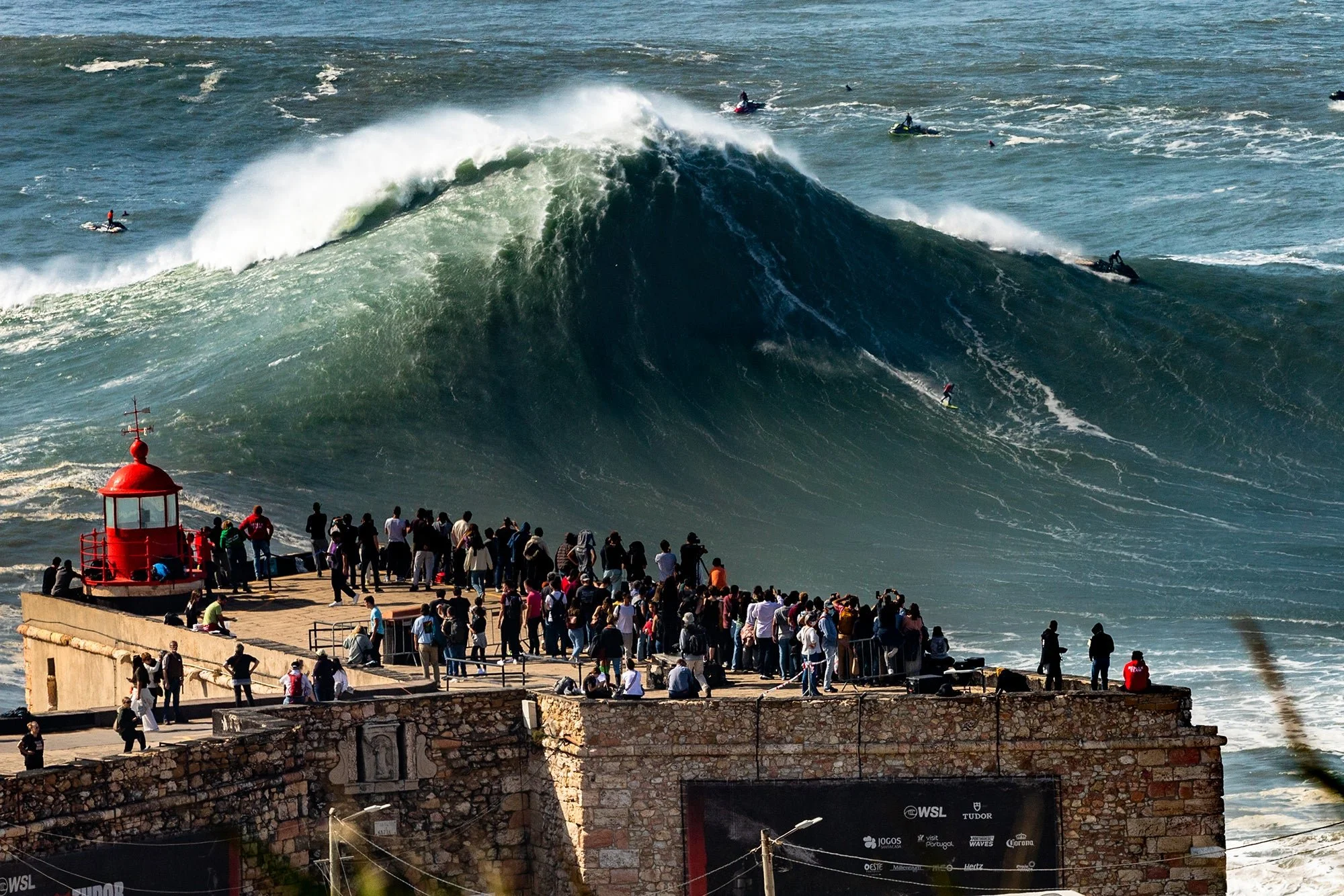
Nazare firing in December 2025 via hurley.com
Nazaré, Portugal is where the ocean turns pressure into a place.
On December 13, 2025, Praia do Norte looked like a moving mountain range as the World Surf League’s TUDOR Nazaré Big Wave Challenge ran in “huge, clean waves” that Reuters reported reached up to 60 feet. Thousands lined the cliffs to watch a format that’s equal parts surfing and survival: two-person teams, jet skis, split-second timing, and a rescue plan that has to work—because the consequences arrive faster than your thoughts.
Brazil’s Lucas “Chumbo” Chianca set the tone immediately with a brutal opening wipeout, then came back to win Best Men’s Performance anyway. France’s Justine Dupont won Best Women’s Performance again, reinforcing her reputation as the standard in women’s big-wave surfing. The day also delivered a very Nazaré kind of reminder: you can be ready and still get humbled. Fog delayed the start, and a power outage shut the event down before a planned second round could safely run.
This is why the “100-foot wave” isn’t just a number. It’s a mental demand: Can you stay calm long enough to do the next correct thing?
Nazaré’s real superpower isn’t size—it’s unpredictability
Nazaré’s waves don’t exist because the surfers are crazy (though they are unusually comfortable with risk). They exist because of geography: the Nazaré Canyon—an enormous undersea trench—funnels and amplifies North Atlantic swell into towering peaks that can detonate close to land.
That canyon is also why Nazaré became the modern symbol of “the biggest wave on Earth.”
In 2011, Garrett McNamara’s tow-in ride at Praia do Norte was ratified by Guinness World Records at 78 feet, and he described it as:
“the most challenging, dangerous wave I’ve ever surfed.”
A decade later, Guinness reported Sebastian Steudtner’s October 2020 ride measured 26.21 m (86 feet)—again at Praia do Norte.
And hovering over all of it is the mythic benchmark: the true, verified 100-foot ride—“surfing’s equivalent of walking on the moon,” as Red Bull framed it while noting the mark “still never been conquered.”
If you’re writing about performance psychology, this matters: the goal is enticing, but the environment refuses to be controlled. That’s the perfect lab for elite mental skills.
2025: Two contest days, same psychological lesson
February 18, 2025: fear doesn’t disappear—you re-prioritize it
Earlier in 2025, the Nazaré Big Wave Challenge ran in windy, bumpy conditions and waves Reuters reported reached up to 35 feet. Dupont returned to competition after having her first child—and gave an unusually honest window into fear management:
“I used to have a lot of fear before. Now, after the baby… it takes my mind off the fear!”
That’s not denial. That’s a change in attentional target: a real-life values anchor that shifts what her brain flags as most important.
She also offered the most accurate performance note you can give for chaotic conditions:
“It was a bit like riding a rodeo out there…”
Translation for every other pressure domain: sometimes your best strategy is accepting volatility and riding it—without overcorrecting.
December 13, 2025: courage is “commitment + rescue”
By December, Nazaré served up bigger, cleaner faces—and heavier consequences. After Chianca’s early wipeout, he said:
“one of the heaviest wipeouts of my life.”
Then, praising his rescue driver:
“Thank you so much, you saved my life today.”
That quote is the whole sport in one line: big-wave performance is individual execution built on team trust.
Dupont, holding her trophy and her young son, summed up the emotional arc of a Nazaré win:
“It was a crazy day, and I’m so happy with the win.”
The mental side, from the people who actually do it
If you want a clean throughline for your Northstar Report audience—sport, business, military, art—this is it:
1) Calm is a skill. They train it on purpose.
Big-wave surfers talk about calm the way strength coaches talk about squat depth: not vibes—reps.
Nic von Rupp describes the appeal of big waves as learning “to stay calm in chaos” and “make peace with fear.” That’s a performance-psych definition of emotional regulation under extreme consequence.
And in practical terms, breath is one of the main levers.
In a first-person piece on breath training, McNamara describes a slow breathing pattern he uses and calls it:
“a very calming oxygenating technique.”
He also describes breath as a way to reduce panic—saying the “fight or flight switch” is effectively turned off when he’s properly oxygenated and calm.
Important safety note for readers: big-wave and breath-hold practices are dangerous if copied casually (especially in water). In the article, treat these as elite-context tools, not DIY challenges.
2) The best don’t “eliminate fear.” They convert it into information.
Von Rupp makes the metaphor explicit:
“Surfing is a metaphor of life… There’s fear in life, whatever you’re doing.”
Later he goes even cleaner:
“turning fear into fuel and moving forward.”
That’s cognitive reappraisal in plain language: fear becomes a data stream (“pay attention”) rather than a stop signal (“don’t go”).
3) They obsess over controllables—because everything else is chaos
Von Rupp puts it like a coach:
“We can control what we can control… preparation, team work, hard work…”
That’s a transferable performance framework across domains:
What you control: preparation, routines, communication, recovery, decision rules
What you don’t: volatility, opponents, weather, the market, the crowd, the judge
4) Their performance environment forces psychological flexibility
Nazaré doesn’t reward rigid plans. It rewards reading reality faster than your ego can argue.
The December 2025 event itself is proof: fog delay, then a power outage, then a forced early finish. You can’t “mentally tough” your way into a second round. You adapt, reset, and live to surf the next swell.
Why surfing might be one of sport’s most “mental” cultures
In many sports, you can hide behind structure: a playbook, a clock, a lane, a fixed surface, a rules-based pause.
In big-wave surfing, the structure is thinner:
The “field” is moving.
The “opponent” is physics.
The “reset button” is your breath under water.
The margin for error is not a missed shot—it can be a rescue.
So surfers build a culture around internal skills that travel well:
breath control
attention control
fear reappraisal
team communication
humility + respect for conditions
That culture also lines up with what research says about mental training in other sports.
A 2024 meta-analysis in Frontiers in Psychology found mindfulness training was associated with improvements in athletes’ performance and reductions in psychological anxiety across included studies (with noted heterogeneity and limitations). And a 2024 meta-analysis in Mindfulness reported slow-paced breathing reliably improved short-term cardiovascular markers (including HRV) and showed a modest effect on negative emotions/perceived stress.
You don’t need to make surfing “mystical” to make it mental. The evidence-based framing is simply: these athletes train state control because their sport demands it.
The Northstar takeaway for every other high-pressure performer
1) Build your “rescue plan” before you need it
Chianca’s win is inseparable from the rescue infrastructure and partner execution behind it.
In other domains: your rescue plan is checklists, abort criteria, escalation paths, a coach, a risk officer, a spotter, a trusted peer.
2) Practice calm when nothing is wrong
McNamara doesn’t wait to breathe well until he’s underwater—he trains breath patterns on purpose.
In other domains: practice downshifting (breath, attention) in training so you can access it in the moment.
3) Treat fear as a signal, not a verdict
Von Rupp’s “fear into fuel” framing is a portable skill.
In other domains: fear can mean “prepare more,” “simplify,” “tighten communication,” or “don’t take this trade.” Not “panic.”
4) Anchor to controllables—fast
When conditions are bumpy, “ride the rodeo.” Don’t demand perfection from chaos.
In other domains: shift from outcome obsession to process obsession when volatility spikes.
5) Perspective is performance-enhancing
Dupont’s motherhood comment is a masterclass in perspective changing fear’s volume.
In other domains: values and identity outside the arena can stabilize you inside it.
Closing: the 100-foot wave is the moment you want to flinch
Most people think “riding a 100-foot wave” is about fearlessness.
Nazaré’s best surfers show the opposite: it’s about fear + skill + calm + team + commitment.
Or, put more simply: the biggest wave isn’t the one in front of you.
It’s the one that hits inside you—right before you choose whether to stay present or get pulled under by your own mind.